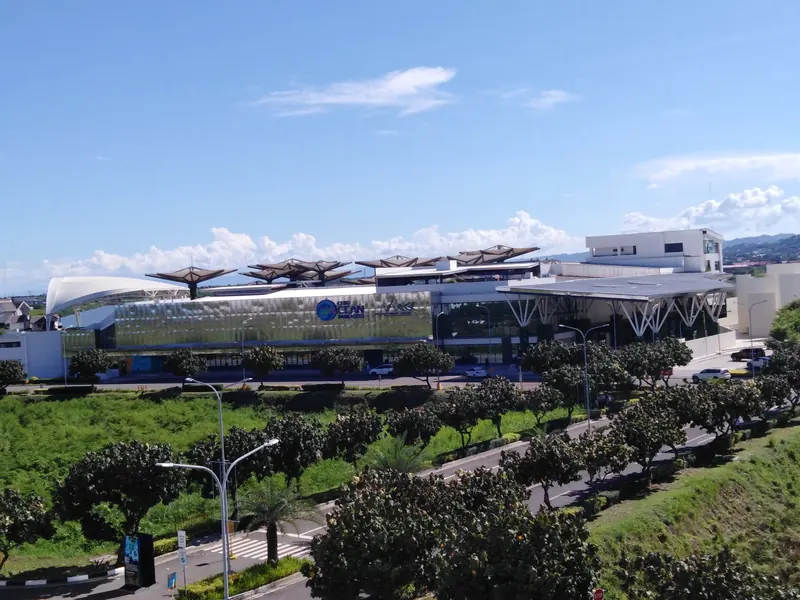
The 1.5 HP split-type inverter section at SM Appliance Ayala stocks roughly fifteen models across nine brands. Sticker prices run ₱22,000–₱55,000 (May 2026) for what looks like the same product. Two days of research will turn up four lists that contradict each other, three TikTok reviews, and a forum thread that ends in mutual accusations. Every one of those lists ranks the brands on two numbers: an EER rating and a compressor warranty.
We went and read what the manufacturers themselves publish on their Philippine websites. Both numbers, as the listicles use them, fall apart. One of them is the wrong metric entirely. The other one points the opposite way from the tier hierarchy it supposedly justifies. An earlier version of this page got both wrong too, and the corrections are in it now.
The EER number is not a Philippine number
Room aircons sold in the Philippines are not labelled on EER. They carry a CSPF star rating (Cooling Seasonal Performance Factor), and Carrier Philippines’ own buyer-education page states it plainly: Philippine aircons “use a star rating system called the Cooling Seasonal Performance Factor or CSPF (previously known as the Energy Efficiency Factor [EEF] or the Energy Efficiency Performance Rating [EEPR])”. EER is the predecessor system. The same page illustrates a label reading 3.86 with five stars.
That scale matters. CSPF figures live in the 3-to-6 range. So does the one figure any maker we checked actually publishes: Daikin Philippines lists an “Energy Efficiency Rating 5.75” on its D-Smart inverter product page. When a listicle tells you a Daikin runs at “EER 15.5” against an industry average of “11.0”, it is quoting a scale that no Philippine energy label uses, for units it has not tested, in a unit system it does not name.
The warranty column is upside down
This one is checkable, and we checked it. Each figure below is read off the brand’s own Philippine site on 12 July 2026.
| Brand | Compressor warranty (maker's own PH site) | Other terms published alongside it |
|---|---|---|
| Koppel (budget tier) | 10 years, inverter split type | 3 years PCB; 1 year parts, labour and consumables. Effective 15 May 2024. Non-inverter: 5 years compressor. |
| Samsung (mid tier) | 10 years, inverter wall-mount and window | 1 year parts and labour. Non-inverter wall-mount: 5 years. Freon chargeable after year one. |
| LG (mid tier) | 10 years, inverter compressor part only | 1 year parts and labour; labour chargeable after year one. |
| Daikin (top tier) | 5 years, D-Smart inverter range | 3 years indoor and outdoor PCB (effective March 2024); 1 year parts and labour. |
| Panasonic (top tier) | Not retrievable | Answered on Panasonic PH's support portal, which does not serve to automated readers. We are not restating a figure we could not open. |
| Carrier (mid tier) | Not published | Carrier PH's terms say warranties "are as stated in the warranty certificate accompanying the product". You cannot know before opening the box. |
Read the table again in tier order. The budget brand publishes ten years. The mid tier publishes ten years. The Japanese flagship publishes five. Whatever you are paying the Daikin premium for, it is not a longer compressor guarantee, and every list that told you otherwise (this page included, until now) was working from numbers nobody had checked.
Two honest caveats. A warranty on the “compressor part only” is not a warranty on the compressor swap: LG’s page is explicit that labour is chargeable after year one, and Samsung’s is explicit that refrigerant is. A ten-year part with a chargeable four-hour labour call is worth real money, but it is not free. And a published term is only as good as the service network that honours it, which is the next section.
What actually separates the tiers
Strip out the two broken numbers and three things are left.
Refrigerant and build. R-32 is now the floor, not a differentiator: Daikin, LG and Koppel all publish R-32 across their current Philippine inverter ranges. Coastal-Cebu buyers should care more about coil coating than badge, because salt air off the Mactan Channel eats heat exchangers.
Local service depth. This is the variable most renters underweight and the one no spec sheet carries. A ten-year compressor warranty on a brand with no Cebu parts inventory is a ten-year promise with a Manila-shipping delay attached. The brands with the deepest accredited service presence in Metro Cebu are the ones you see in every mall showroom, which is not a coincidence and is worth more than a spec line.
Price. Which is the one thing you can see for yourself, and the one thing we cannot cite.
Cebu retail pricing, and what it is worth
| Top — Daikin / Panasonic / Mitsubishi | Mid — Carrier / LG / Samsung / Hitachi | Budget — Koppel / TCL / Midea / Haier | Non-inverter window — Fabriano / GE / Kolin | |
|---|---|---|---|---|
| 1.5 HP price band (Cebu retail, May 2026) | PHP 40,000–55,000 | PHP 30,000–40,000 | PHP 22,000–28,000 | PHP 12,000–18,000 (mostly 1.0 HP) |
| Compressor warranty published? | Daikin: 5 yr. Panasonic: not retrievable. | LG and Samsung: 10 yr. Carrier: not published. | Koppel: 10 yr. Others not checked. | Koppel non-inverter: 5 yr. Others not checked. |
| Best for | High-use, long tenure, if you are buying build quality rather than warranty | Most renters — deepest service network and a published 10-year term | Shorter tenure, modest run-time, and a published 10-year term worth reading | Guest rooms and low-usage only |
Where to buy has not changed. SM Appliance Center (Ayala, SM City Cebu, SM Seaside) carries the deepest stock of the Japanese and Korean ranges. Abenson and Anson’s carry a similar spread with a stronger Mitsubishi presence, and the Anson’s branch on A.S. Fortuna in Mandaue is the largest aircon showroom in the metro. Western Appliance bundles installation packages. For the budget tier, Lazada and Shopee deliver to Cebu with manufacturer warranty intact, and installation is billed separately: local Cebu installer rates run ₱3,500–₱5,500 for a 1.0 HP split, well below Metro Manila quotes. Those installer and service figures are our own trade observation and carry the same provenance warning as the retail bands.
What the brand decision is actually worth per month
Less than the rate you pay for power, and the rate is the number we can actually stand behind.
Visayan Electric’s residential all-in rate is currently ₱14.96/kWh (Visayan Electric, 2026-08-20 (primary — utility's own peso figure), Aug 2026). It moves every cycle: PHP 11.13/kWh in the February 2025 cycle, and it has climbed through 2026 to the figure above, each point dated to a billing cycle and sourced in the Cebu electricity rate dataset. The current August 2026 figure is primary: Visayan Electric published the peso number itself on 20 August 2026. July before it was primary too, and carried a caveat August does not: ERC approval to defer part of the generation-cost recovery held that cycle well below where it would otherwise have landed, and the deferral is recovered later, so July’s ₱14.90 understates what July power actually cost to supply. The June 2026 point behind it is weaker, carried by a named secondary (SunStar Cebu) because the utility published drivers and no peso figure that cycle. We say so rather than smoothing it over.
▸ Show the data table
| Billing cycle | ₱/kWh | Source |
|---|---|---|
| Feb–Mar 2025 cycle | ₱11.13 | Philstar / The Freeman |
| Aug–Sep 2025 cycle | ₱11.60 | Philstar / The Freeman |
| Sep–Oct 2025 cycle (2025 peak) | ₱12.51 | SunStar Cebu |
| Oct–Nov 2025 cycle | ₱11.51 | Philstar / The Freeman |
| January 2026 | ₱11.72 | Newsline Philippines (single source — re-verify) |
| February 2026 (+₱0.35) | ₱12.79 | Philstar / The Freeman; SunStar Cebu |
| March 2026 | ₱12.36 | Visayan Electric official (stated in April announcement) |
| April 2026 (+₱0.21) | ₱12.57 | Visayan Electric official |
| May 2026 (+₱0.31) | ₱12.88 | Visayan Electric official, May 2026 cycle |
| June 2026 (+₱0.86) — named-secondary only | ₱13.74 | SunStar Cebu, 2026-06-28 (named secondary — Visayan Electric published no June peso figure) |
| July 2026 (+₱1.16, 2026 high) | ₱14.90 | Visayan Electric, 2026-07-18 (primary — utility's own peso figure) |
| August 2026 (+₱0.06) | ₱14.96 | Visayan Electric, 2026-08-20 (primary — utility's own peso figure) |
That is a real, dated, published series, and it moved further in eighteen months than any plausible brand-to-brand efficiency gap would move your bill. The lever is hours of runtime and the rate, not the badge. Put your own hours and unit size through the cost calculator; the methodology shows exactly how the rate is verified, including where it is only named-secondary sourced.
Service support: the variable most renters underweight
Multi-brand servicing in Metro Cebu is a real market, and the accredited networks are concentrated around the brands you see in the mall showrooms: Daikin, Panasonic, LG, Mitsubishi, Carrier and Samsung all have accredited service partners in Cebu carrying stocked parts. Standard deep-clean rates run PHP 750–₱1,200 and a refrigerant top-up runs ₱1,800–₱3,500 depending on charge (again: our own trade observation, not a published tariff).
The structural risk is not brand quality, it is parts logistics. Any unit whose importer has no Cebu parts inventory (including a unit brought in personally without a Philippine warranty) means a wait on Manila stock for anything beyond a routine failure. That delay through the March-to-May dry season is what turns a small saving on purchase into an expensive one.
The take
Buy on service network and on the warranty the maker actually publishes, and check both yourself on the maker’s own Philippine site before you walk into the showroom. That takes four minutes and it will contradict most of what you have read, including our own earlier version of this page.
What the evidence supports in July 2026: LG, Samsung and Koppel publish a ten-year compressor term; Daikin publishes five; Carrier publishes nothing you can read before you open the box. What the evidence does not support is a cross-brand efficiency ranking, in EER or in anything else, because only one of these makers publishes an efficiency figure for its Philippine models at all. The honest answer to “which brand is most efficient” is that the published record does not say, and the peso saving that would follow from it does not exist as a number anyone can defend.
FAQ
Frequently asked.
Which aircon brand has the longest compressor warranty in the Philippines?
What is the most energy-efficient aircon brand in the Philippines in 2026?
Can budget brands like Koppel, TCL, and Midea be trusted in Cebu?
Where do you check an aircon warranty before you buy in the Philippines?
Data note. Prices, rates, and details are verified as of publication and may change. Always confirm with the listed provider or landlord before committing. This article is informational, not financial, legal, or immigration advice. Full disclaimer.