The Anti-Hospital Deposit Law (Republic Act 10932), signed August 3, 2017, makes it a criminal offence for any Cebu hospital, public or private, to demand a deposit or advance payment as a prerequisite to administering emergency medical treatment. For the staff member or officer involved, refusal carries a fine of PHP 100,000 to PHP 300,000, or imprisonment of six months and one day to two years and four months, or both. Where the refusal follows hospital policy, the responsible director or officer faces a PHP 500,000 to PHP 1,000,000 fine, or four to six years of imprisonment, or both. Three repeated violations revoke the facility’s DOH licence. The law applies identically to foreigners and Filipinos, insured and uninsured, conscious and unconscious.
That settles the first worry. You will be treated. The harder questions are what happens after stabilisation, how the bill flows, which Cebu ER actually fits the situation, and whether to call an ambulance or get in a Grab. The broader healthcare cost overview covers monthly budgets, HMO vs PhilHealth, and routine care. What follows is the emergency-only runbook, and none of it replaces a clinician’s assessment on the day.
The legal floor: RA 10932 in practice
The Anti-Hospital Deposit Law replaced the weaker Batas Pambansa 702 of 1982. The 2017 update closed three loopholes that hospitals had used for decades to refuse non-paying ER admissions: it removed the “ability to pay” defence, criminalised institutional policies that produced refusals, and added a legal presumption of hospital liability if a refused patient dies, suffers permanent disability, or (for a pregnant woman) loses the unborn child.
In practice, in 2026, the major Cebu hospitals admit walk-in emergency cases without asking about insurance or a deposit at the door. Triage happens immediately. The triage nurse will request a name and an emergency contact, and that is the extent of the paperwork before treatment begins.
The deposit question reappears after stabilisation. Once the patient is medically stable and the decision is made to admit them to a room or discharge them with a prescription, the cashier or admissions office will present a bill or a deposit request. This is legal. The law prohibits the deposit demand as a prerequisite to emergency treatment, not as a condition of inpatient admission. Admission deposits are set by each hospital and none of the five publishes its schedule, so treat any figure you read online (including a figure this site used to print) as unverified. Ask the admitting desk for the number in writing before you agree to the room.
Which Cebu ER for which situation
Proximity is the strongest variable when minutes matter. All five hospitals below run 24-hour emergency departments. Addresses and trunklines are as published by each hospital.
| Hospital | Address (as published) | Trunkline | When to choose |
|---|---|---|---|
| Cebu Doctors' University Hospital | Osmeña Boulevard, Capitol Site, Cebu City | (032) 255-5555 | Capitol, Colon, central Cebu City |
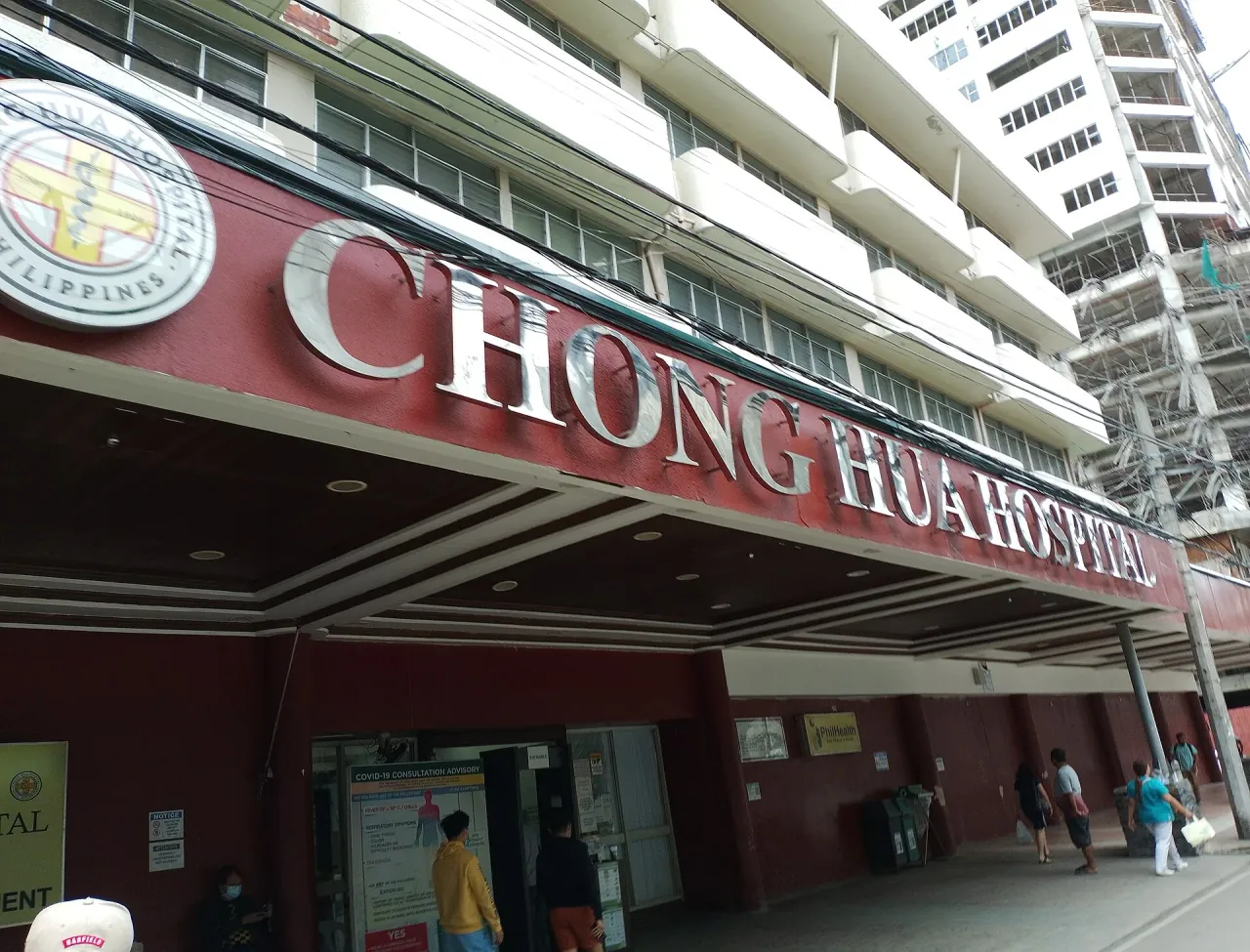
| Chong Hua Hospital (Cebu City) | Don Mariano Cui St. cor. J. Llorente St., Capitol Site | (032) 255-8000 | Downtown, Capitol Site, Mabolo |
| Chong Hua Hospital (Mandaue) | Mantawi International Drive, Mandaue City | (032) 233-8000 | Mandaue, A.S. Fortuna, Mactan bridge access |
| Perpetual Succour Hospital | Gorordo Avenue, Lahug, Cebu City | (032) 233-8620 | IT Park, Lahug, Banilad |
| University of Cebu Medical Center (UCMed) | Ouano Avenue, Guizo, Mandaue City | (032) 517-0888 | Mandaue, Mactan, Consolacion |
| Vicente Sotto Memorial Medical Center | B. Rodriguez Street, Cebu City | Public tertiary (DOH) | Public option, trauma volume, when private ERs are full |
The honest answer to “which is the best Cebu hospital” is the one you can reach fastest. We deliberately do not rank them by stroke or cardiac capability. Accreditations of that kind are exactly the sort of claim a reader would act on in a time-critical emergency, and we could not confirm any of them against a published DOH list. Drive to the nearest tertiary ER and let the emergency physician route you.
The ambulance question
This changed recently, and the old numbers are still in circulation. Until September 2025 the Philippines ran dozens of parallel local emergency numbers. The DILG then launched a Unified 911, a single nationwide hotline consolidating the old local lines and routing police, fire, medical and disaster calls through one integrated network, with a stated target answer-to-response time of five minutes (DILG, reported by GMA News Online, 11 September 2025; DILG’s own release is the underlying source, and we cite the news report because DILG’s server did not respond to us). In Cebu City, ambulance calls have long answered on 161, the line run by the Emergency Rescue Unit Foundation (ERUF).
For a patient who is conscious, breathing and able to be moved by a companion, going beats calling. You control the departure time; you do not control the dispatch queue. For most expat-facing emergencies (a motorcycle crash with the rider walking, suspected appendicitis, a food-poisoning collapse, dengue dehydration), a Grab to a tertiary ER is the faster answer.
Call rather than move when:
- Spinal injury is possible (any fall from height, any motorcycle accident with neck or back pain)
- The patient is seizing, or is unconscious after a seizure
- Bleeding needs continuous pressure
- A stroke is suspected and the patient cannot walk
- Cardiac arrest, or severe chest pain
Have the address ready with a landmark behind it, because a nearby mall works better than a street name in Cebu. Keep a phone on the line, and send a companion outside to flag the ambulance at the gate.
Arrival to discharge
Triage comes first: a nurse takes vitals and a brief history, and this is the moment to hand over the allergies-and-medications note from the kit below. The duty emergency physician assesses next, ordering labs or imaging if the case needs them. Then the decision splits: treat and discharge with a prescription, or admit. Payment settles at the central cashier, and prescriptions are usually cheaper at one of the pharmacy chains outside than at the in-hospital counter.
If admission follows, a companion handles the paperwork while the patient moves to a room. That is where the deposit conversation happens, and it is legal.
What the hospitals actually publish
Here is the figure this page will not give you. No Cebu hospital publishes an emergency-room fee or an emergency physician’s fee. They are not on any of the five hospitals’ sites, and no regulator publishes them either. So this article does not print one. A number we cannot source is a number we do not ship, and the version of this page that carried a confident “typical ER bill” range was carrying a figure with nothing behind it.
What is published, in detail and with effective dates, is the diagnostics. Chong Hua Cebu City runs a public price list, and it is the most useful document in Cebu healthcare that almost nobody reads.
| Item | Published price | Effective |
|---|---|---|
| Complete blood count (CBC) | PHP 450 | 19 Sep 2025 |
| Urinalysis | PHP 350 | 19 Sep 2025 |
| Chest X-ray (PA or AP) | PHP 509 | 18 Nov 2025 |
| ECG | PHP 1,050 | 18 Nov 2025 |
| Ultrasound, any one organ | PHP 1,561 | 18 Nov 2025 |
| Ultrasound, whole abdomen | PHP 3,520 | 18 Nov 2025 |
| CT brain, plain | PHP 5,480 | 18 Nov 2025 |
| CT chest, plain | PHP 8,665 | 18 Nov 2025 |
| MRI brain | PHP 13,246 | 19 Sep 2025 |
Read the shape of that table rather than the individual rows. Bloods and a chest film are the cheap part. The imaging decision is what moves a bill by an order of magnitude, and a plain brain CT at ₱5,480 (Nov 2025) is on its own worth more than the entire lab panel. When the doctor orders a scan, that is the moment to ask what the workup will total, and Cebu ERs will give you a written estimate if you ask for one.
Room rates are also published. Chong Hua Cebu City lists a ward bed at ₱1,200/day and a regular private room at ₱2,800/day (published room rates). UCMed lists a ward bed at ₱1,250/day, a private room at ₱2,950/day and an ICU bed at ₱7,850/day (UCMed rooms, effective 1 May 2022 and, on the hospital’s own note, subject to change). Those are room charges only. Nursing, professional fees and medication stack on top, and no hospital publishes what that stack comes to.
The other side of the market is public. Section 9 of the Universal Health Care Act (RA 11223) states that “no co-payment shall be charged for services rendered in basic or ward accommodation” in a public hospital. That is the mechanism behind Vicente Sotto’s low cost. It is a PhilHealth-member benefit, though, and automatic NHIP inclusion under the Act runs to Filipino citizens, so a foreigner reaches it only by being an enrolled member.
PhilHealth, if you are a member
PhilHealth’s Outpatient Emergency Care Benefit (Circular 2024-0033) covers outpatient emergency cases in accredited level 1 to 3 hospitals, which includes the Cebu private tertiaries. PhilHealth’s own announcement puts the benefit live from 14 February 2025. It pays fixed amounts per service against an essential emergency care list, and you pay the excess. It is not a ceiling on your bill; it is a subsidy against specific line items.
Whether you can use it depends on which foreigner you are, and the branches split like this:
- Employed in the Philippines on a formal contract: you are an ordinary Direct Contributor, at 5% of monthly basic salary, PHP 10,000 floor to PHP 100,000 ceiling, split with your employer (PhilHealth Advisory 2025-0002, rate unchanged for 2026).
- SRRV retiree: PHP 15,000 a year, flat.
- Any other foreign resident (ACR I-Card, not formally employed): PHP 17,000 a year, flat.
The flat figures come from PhilHealth Circular 2017-0003 and PhilHealth still prints them in its Citizen’s Charter 2026. Worth knowing before you rely on them: that circular predates the Universal Health Care Act and PhilHealth has never issued a post-UHC circular restating the foreign-national category. It survives as an unrepealed 2017 issuance. Expect variation between local health insurance offices, and confirm at the counter before you pay.
What to bring: the five-item ER kit
Keep these together. If anything happens, you grab one zip pouch and walk out.
- Passport or ACR I-Card. A valid government-issued photo ID is required for admission paperwork. The ACR I-Card is accepted and is more practical than the passport to carry daily.
- HMO card and/or international insurance card, with the policy number visible and the 24-hour claims line written on the back. Photograph both sides and back the photo up, so a companion can retrieve it remotely.
- Cash. The in-hospital pharmacy and individual specialist booths sometimes take only cash even where the main cashier takes Visa and Mastercard, and there is the taxi home. How much is your call; we are not going to invent a number for your wallet.
- Current-meds and allergies note. One index card: blood type if known, allergies (antibiotic and anaesthesia especially), current daily medications with dosages, chronic conditions. Hand it to the triage nurse on arrival.
- Emergency contact list with at least one in-country number. Someone who can deliver paperwork, bring a charger, or front a card. An out-of-country contact is not a substitute.
Common scenarios
Motorcycle accident. Suspect head, neck and spine until a doctor has ruled them out. Do not move the patient unless a companion has clear training, do not remove the helmet unless the airway is blocked, keep the patient warm, and call. Go to a tertiary hospital with a full emergency department rather than the nearest clinic, because a clinic cannot image a head or stabilise a spine, so it will send you onward and cost you the interval. Expect an observation period for anyone who lost consciousness, however recovered they look on arrival.
Dengue. Symptoms peak in the days after infection and Cebu cases concentrate in the wet months; the dengue prevention playbook covers the warning signs that should send you to an ER rather than a clinic. Severe abdominal pain, persistent vomiting and bleeding gums are the ones that end the debate. Inpatient management is daily blood-count monitoring and fluid replacement, routine work at any tertiary hospital in the city. The admission threshold is a clinical call, not a number you should be making yourself.
Food poisoning and severe gastro. Most cases are an observation period with IV fluids, treated and discharged rather than admitted. If there is a high fever, blood in the stool, or signs of dehydration in a child or an elderly patient, do not wait it out. Go in.
Stroke or chest pain. Time is the only variable you control and it is the one that decides the outcome. The question is not which facility is best but which large one you can reach fastest. Go to the nearest tertiary hospital with a full emergency department, not the nearest clinic, because a clinic will assess you and then send you onward and you pay for that interval twice. If a companion can phone the ER trunkline while you travel, have them do it, because the ER can assemble the team before the patient is through the door. Note the clock time the symptoms started and give triage that number first. It is the single fact that determines which treatments are still available.
Typhoon and earthquake injuries. During named disasters, hospital capacity is allocated to triage tiers, Vicente Sotto absorbs the heaviest trauma, and private hospitals often run on generator power. The typhoon preparedness and earthquake preparedness guides cover pre-event hospital-access planning.
Pre-emergency setup, before anything happens
A short list for the first month in Cebu.
Identify the nearest tertiary ER and drive or Grab the route once, on a calm afternoon. Most Cebu hospitals put the ER entrance somewhere other than the main admissions entrance, and the difference matters at 2 AM. Program that hospital’s trunkline into your phone from the table above. Photograph your insurance card, both sides, and back it up where a companion could reach it. Build the five-item kit and put it in a drawer you can find in the dark.
A medical emergency in Cebu is survivable, competently handled, and not financially opaque once you know which documents to read. The unprepared version is slower and more expensive, usually because a companion is hunting for a passport, an insurance card sitting in a forgotten email, or an allergy nobody can recall at the wrong moment. Five minutes of preparation on a calm Sunday is worth several hours of relief on a chaotic Tuesday.
FAQ
Frequently asked.
Will a Cebu hospital refuse to treat me in an emergency without a deposit?
How much does a Cebu emergency room visit cost in 2026?
Should I call 911 or take a Grab to the hospital in Cebu?
Which Cebu hospital ER should I go to in 2026?
What do I bring to a Cebu emergency room as a foreigner?
Data note. Prices, rates, and details are verified as of publication and may change. Always confirm with the listed provider or landlord before committing. This article is informational, not financial, legal, or immigration advice. Full disclaimer.