The budget end of the Cebu rental market is the part nobody can price properly, including us. Below a certain rent, listings stop being published, operators stop naming a rate, and the “cheapest rentals in Cebu” listicles start quoting each other. So this playbook does two things at once: it gives you the tiers we can price, against a baseline we publish and label, and it tells you plainly where our own numbers run out.
Everything volatile here is bound to something you can check. Electricity reads live from the Visayan Electric ledger, water from the MCWD ledger, and rent from the Cebu rent baseline, which is an editorial estimate with no listing sample behind it and says so on every surface it appears. The basis for all three is set out on our methodology page.
What We Can Price, and What We Cannot
Our Cebu rent baseline holds 21 neighbourhood-by-unit-type segments. Five of them sit in the budget band, and they are the honest spine of this article.
| Category | Range | Notes |
|---|---|---|
| Boarding-house room — Capitol / Colon | ₱3,500–₱8,000 | Private door, shared or semi-private bath, no kitchen |
| Boarding-house room — Talamban | ₱3,500–₱7,000 | University belt around USC and CIT-U |
| Studio — Capitol / Colon | ₱5,000–₱12,000 | The only sub-₱10,000 studio band on the baseline |
| Studio — Mabolo | ₱10,000–₱18,000 | Bottom of the band only; walking distance to IT Park |
| Studio — Mandaue | ₱10,000–₱18,000 | Bottom of the band only; A.S. Fortuna corridor |
LiveInPH Cebu rent baseline — an editorial estimate, not a measured sample. n = null on every segment; no listings were counted and no dated portal snapshot was retained. Full segment table at /data/cebu-rent-index.
Read those bands as a prior, not as evidence. They are LiveInPH’s own reading of Cebu asking rents in early 2026. No sample was collected, so there is no median, no quartile, and no “typical” figure to quote. The midpoints you see elsewhere on the site are arithmetic ((low + high) ÷ 2), not statistics. Asking rent, not transacted rent. A counted, dated listing collection is the next thing we owe this dataset.
▸ Show the data table
| Segment | Low | Midpoint | High | n |
|---|---|---|---|---|
| IT Park / Cebu Business Park · Studio | ₱18,000 | ₱26,500 | ₱35,000 | — |
| IT Park / Cebu Business Park · 1BR | ₱25,000 | ₱40,000 | ₱55,000 | — |
| IT Park / Cebu Business Park · 2BR | ₱40,000 | ₱80,000 | ₱120,000 | — |
| Lahug · Studio | ₱14,000 | ₱19,500 | ₱25,000 | — |
| Lahug · 1BR | ₱20,000 | ₱27,500 | ₱35,000 | — |
| Banilad · Studio | ₱12,000 | ₱16,000 | ₱20,000 | — |
| Banilad · 1BR | ₱18,000 | ₱24,000 | ₱30,000 | — |
| Banilad · 2BR | ₱30,000 | ₱47,500 | ₱65,000 | — |
| Banilad · 3BR | ₱50,000 | ₱60,000 | ₱70,000 | — |
| Mabolo · Studio | ₱10,000 | ₱14,000 | ₱18,000 | — |
| Mabolo · 1BR | ₱20,000 | ₱27,500 | ₱35,000 | — |
| Mabolo · 2BR | ₱28,000 | ₱37,000 | ₱46,000 | — |
| Mabolo · 3BR | ₱45,000 | ₱55,000 | ₱65,000 | — |
| Mandaue · Studio | ₱10,000 | ₱14,000 | ₱18,000 | — |
| Mandaue · 1BR | ₱17,000 | ₱26,000 | ₱35,000 | — |
| Mandaue · 2BR | ₱15,000 | ₱17,500 | ₱20,000 | — |
| Capitol / Colon · Studio | ₱5,000 | ₱8,500 | ₱12,000 | — |
| Capitol / Colon · Room | ₱3,500 | ₱5,750 | ₱8,000 | — |
| Talamban · Studio | ₱12,000 | ₱18,500 | ₱25,000 | — |
| Talamban · 1BR | ₱26,000 | ₱30,000 | ₱34,000 | — |
| Talamban · Room | ₱3,500 | ₱5,250 | ₱7,000 | — |
The published gap: bedspace. Bedspace and shared-bunk arrangements are the real floor of this market, and we do not publish a number for them. Nobody does. Cebu bedspaces are advertised on Facebook groups, TikTok and hand-lettered gate signs, not on portals with a rate card, and no government or industry body monitors the price. We have not counted a sample either. Rather than transcribe a figure from a listicle that got it from another listicle, we are saying it straight: the bedspace tier is unmeasured. When you view one, the price you are quoted is the only data point that exists, and it is worth asking whether it includes water and whether there is an electricity cap.
The Four Tiers
Tier 1: bedspace or shared bunk. A bed in a shared room, sometimes two beds, sometimes six. Shared bathroom, fan only, kitchen access if there is a kitchen at all. Often the quoted rate folds in water and a flat electricity allowance that stops applying the moment you plug in a personal aircon. This tier concentrates in Capitol Site, Colon and the Talamban belt within walking distance of USC, USJR, CIT-U and University of Cebu. For most working adults it is a stopgap, not a setup. See the gap note above for why we quote no price.
Tier 2: private boarding-house room (₱3,500–8,000 on the baseline). A real door and a real lock. Often a private bathroom, sometimes one shared between two to four rooms. A bed, a wardrobe, no kitchen of your own, and a shared cooking area with a stove and a fridge. Water and security are frequently bundled; a separate Visayan Electric meter almost never is, which is where the sub-meter question in the next section starts to matter. Capitol Site and Colon mid-rises carry this tier in volume, as do the older walk-ups on Mabolo’s interior streets.
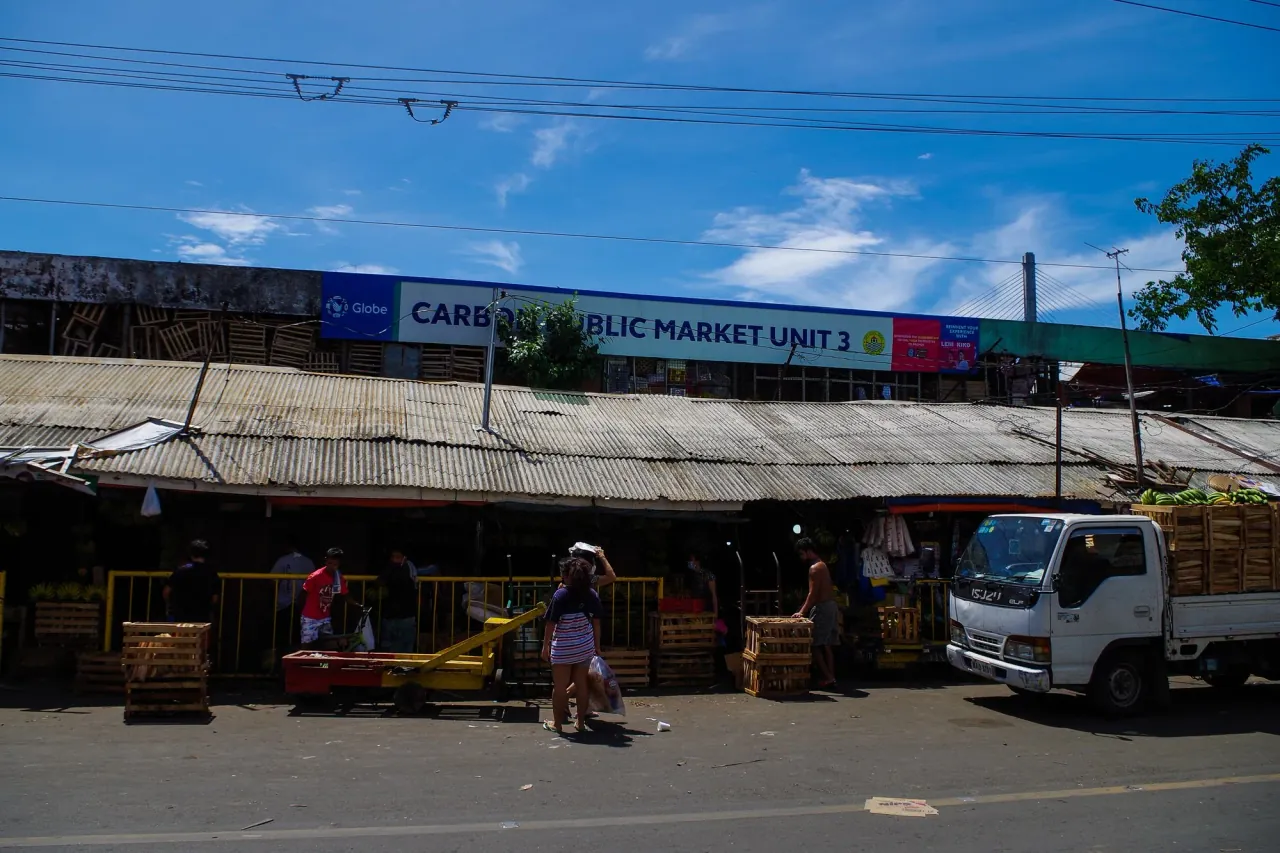
Tier 3: downtown budget studio (₱5,000–12,000 on the baseline). The Capitol/Colon studio band is the only one on our baseline that reaches below ₱10,000, and it is the practical budget sweet spot: a self-contained unit with a private bathroom, a kitchenette, usually an aircon the landlord installed some years ago, and, in the better stock, separate utility meters. The trade is the neighbourhood. Older buildings, a busy street-level environment, and dry-season air quality along the jeepney corridors. It is also worth knowing that the downtown core is where the flood-hazard mapping concentrates: Kalubihan, Kamagayan, Tinago, Day-as, T. Padilla and San Roque all sit on the MGB Region 7 list of the city’s 22 most flood-susceptible barangays, most of them along rivers, creeks or the coast. Budget stock and flood exposure overlap in Cebu more than the price alone would suggest, so ask which floor the unit is on and what happened to it in July. What you get back is Carbon Market on foot for groceries, jeepney terminus access to most of metro Cebu, and Cebu Doctors’ University and Vicente Sotto Memorial Medical Center nearby.
Tier 4: mid-city studio, bottom of the band (₱10,000–12,000). Mabolo and Mandaue studios both start at ₱10,000 on the baseline and run to ₱18,000, so only the bottom third of each band is a budget product. Mabolo buys you the shortest commute in this article: the interior streets around F. Cabahug and Don Gil Garcia put IT Park inside a walk, which is why night-shift BPO workers pay the premium. What the listings there leave out is that Mabolo is one of the 22 barangays the Mines and Geosciences Bureau’s Region 7 hazard mapping names as most susceptible to flooding, alongside Guadalupe, Labangon, Tisa, Talamban and Banilad. When about four hours of rain put water across downtown Cebu on 30 July 2026, the city’s disaster office was pulling trapped residents out of Mabolo. Convenient and exposed are both true of the same address. Mandaue’s A.S. Fortuna corridor buys you space instead. The full picture on each sits in the Mabolo neighborhood guide and the Mandaue neighborhood guide.
Above roughly ₱12,000 the conversation stops being about budget. The monthly rentals pricing guide maps the range above this one.
The Total-Monthly Multiplier
A cheap listing is not a cheap month. The multiplier from rent to total housing cost runs higher at the bottom of the market than anywhere else in Cebu, for a boring structural reason: the peso amounts on utilities have floors, and they do not shrink when your rent does.
Work it with the midpoint of the Capitol/Colon studio band, ₱8,500. That midpoint is arithmetic, not a typical rent, but it is the figure our own dataset would hand you.
| Category | Range | Notes |
|---|---|---|
| Rent (Capitol/Colon studio, band midpoint) | ₱8,500–₱8,500 | Editorial baseline midpoint, not a measured typical |
| Visayan Electric (250–350 kWh, non-inverter aircon) | ₱3,723–₱5,212 | Live ledger rate × stated consumption assumption |
| MCWD water (single occupant, 10–13 cu.m.) | ₱259–₱345 | Minimum charge plus tier-2 commodity rate |
| Internet (Converge BIDA 888, up to 75 Mbps) | ₱888–₱888 | Published plan price, verified 2026-07-12 |
| Total monthly housing | ₱13,370–₱14,945 |
Electricity: the live Visayan Electric all-in residential rate from our ledger, times the stated consumption band. Water: the live MCWD tariff. Internet: convergeict.com/bidafiber, checked 2026-07-12. The kWh band is a stated editorial assumption, not an observation.
The electricity line reads the live rate: Visayan Electric is currently at ₱14.89/kWh, September 2026 (−₱0.07) (Visayan Electric, 2026-09-26 (primary — utility's own peso figure), Sep 2026). Water reads the live tariff: ₱259.16 (first 10 cu.m.) (MCWD via Philstar / The Freeman — final 10% tranche, effective 2026-04-01, Apr 2026) [Sourcing note: MCWD publishes NO residential tariff schedule on its own website. Every peso figure in this ledger (minimum ₱259.16 / 10 cu.m.; tiers ₱28.64, ₱33.71, ₱82.52) is attributed to MCWD via NAMED SECONDARIES — Philstar / The Freeman (2026-03-28) and Cebu Daily News — not via a primary MCWD publication.]. The internet line is the cheapest reliable fibre plan Converge publishes for Cebu, BIDA 888 at ₱888/month for up to 75 Mbps.
That lands the month at roughly ₱13,370–14,940 against a ₱8,500 rent, which is a multiplier of 1.6 to 1.8. At ₱62.49/USD (BSP RERB, 10 Sep 2026) that is about USD 214–239 all in. Run the same stack on an ₱18,000 IT Park studio and the multiplier falls to about 1.3, because the utilities barely move. The squeeze at the bottom is structural, not bad luck.
That multiplier is also worse than it was in July, and the reason is a single line in the table. When this page last ran the stack, on 12 July, the same studio came out at 1.5 to 1.7. Nothing about the unit changed. Visayan Electric’s rate did, and because the rent it divides into is small, a peso on the electricity line moves the multiplier here about twice as hard as it would on an IT Park studio.
The one lever you actually control is the aircon. Drop from a non-inverter running most of the night to fans and cross-ventilation, and consumption falls to something like 100 to 160 kWh, which at the current rate is ₱1,489–2,382 rather than ₱3,723–5,212. That is roughly ₱2,230–2,830 a month, or a quarter of the rent at this tier. The VECO savings guide for renters has the inverter-versus-non-inverter arithmetic and the room-position decisions that change how long the compressor actually runs.
The Sub-Meter Question
This is the check that matters most at the budget tier, and it is the one the listings never answer.
Many older walk-ups in Capitol, Colon and Mandaue do not give each unit a Visayan Electric meter. The building has one connection, the landlord reads a private sub-meter for each unit, and bills you at a rate of their choosing. Sub-metering is common and is not by itself unlawful. The problem is that the rate is invisible until the first bill arrives, and the tenant usually has nothing to compare it against.
Here is the rule that decides whether a sub-meter line is lawful. Selling electricity at a profit is not a thing a landlord may do. Distributing and selling power to end users at a margin requires a franchise, and a boarding house does not have one, so a sub-meter is a cost-recovery device rather than a small utility business. Recovering an administrative or maintenance cost is fair, but it belongs on its own disclosed line that you agreed to in advance, not folded invisibly into a fatter per-kWh number.
We are going to be honest about the strength of that statement. It is the settled reading across Philippine legal commentary on sub-metered billing, and the principle behind it (a franchise is what licenses the sale of electricity) is not in dispute. What we could not do is put a resolution number on it: the Energy Regulatory Commission’s site refuses our requests, and the one resolution commonly cited for this in secondary write-ups turns out, in the Supreme Court’s own e-library, to be about the testing and maintenance of distribution-utility meters instead. So we give you the principle and the paper trail to demand, and we are not going to quote you a citation we have not read.
You do have something to compare it against: the published all-in residential rate, ₱14.89/kWh (Visayan Electric, 2026-09-26 (primary — utility's own peso figure), Sep 2026). That is the number a directly-billed household pays, generation and transmission and taxes included. So the question to a landlord is not “is there a sub-meter” but:
- Is this unit billed directly by Visayan Electric, or through your sub-meter?
- If sub-metered, what is the per-kWh rate, and will you put it in the lease?
- Will you show me the building’s Visayan Electric bill alongside mine on request?
A landlord who answers all three in writing is fine. A landlord who will not name a rate is the risk, whatever that rate turns out to be.
Note that the benchmark itself moves, and it has moved a long way. Visayan Electric’s residential rate has run between ₱11.13 and ₱14.96/kWh across the cycles in our ledger, so a per-kWh figure that looked like a markup last year may be at cost this year. This is not academic: the rule of thumb passed around Cebu tenant groups, that anything over ₱14/kWh is a scam, now sits below the published rate outright. Apply it in September 2026 and you would accuse a landlord who is charging you exactly what the utility charges them. Compare against the current cycle, not a number you remember. The published series is at /data/cebu-electricity-rate, and Cebu electricity bills for renters walks the full bill line by line.
One caveat on the benchmark’s recent history: July’s ₱14.90 was a held-down number. Visayan Electric published it on 18 July 2026, and said in the same post that generation charges hit roughly ₱11.00/kWh and the all-in rate would have reached ₱17.59 had the ERC not approved deferring part of the recovery into later cycles. That deferred balance comes back on a schedule nobody has published. So when you write a per-kWh cap into a lease, write it as “the published Visayan Electric all-in residential rate for the cycle” rather than a fixed peso number, or you will be renegotiating it.
Rent Control Actually Covers This Article
Almost every guide to renting in Cebu treats the Rent Control Act as background law. At this price tier it is not background, it is the price tier. RA 9653 covers residential units in the National Capital Region and other highly urbanized cities renting from ₱1 to ₱10,000 a month, and from ₱1 to ₱5,000 everywhere else (Section 5). PSA classifies Cebu City, Mandaue and Lapu-Lapu all as highly urbanized cities, so the ₱10,000 bracket runs across the whole metro rather than stopping at the city line.
Look back at the tiers. Boarding-house rooms, the Capitol and Colon studio band, and the bottom of Mabolo and Mandaue all sit at or under ₱10,000. Tiers 1 through 3 of this article are inside the covered bracket. Almost nothing else on this site is.
Inside the bracket, Section 4 caps the annual increase at 7% for as long as the unit is occupied by the same lessee. The operative cap is currently far lower than the statute: NHSB Resolution 2024-01 keeps rent regulation running from 1 January 2025 through 31 December 2026 and sets the allowable increase at 1% for 2026, against 2.3% for 2025, on covered units where the same tenant renews.
Two practical consequences. First, renewing is worth more money at this tier than at any other, so weigh a modest annoyance against a reset you cannot appeal. Second, if your increase arrives above the cap and you are the sitting tenant in a covered unit, that is not a negotiation, it is a rule, and RA 9653 attaches fines and possible imprisonment to violations. Raise it in writing, cite the resolution, and keep the reply. What a landlord can lawfully demand up front is a separate question, and security deposits and Cebu rental law covers it.
One sourcing note, because this matters more than usual on a legal point. We read RA 9653 in full text. The 1% figure for 2026 we did not read at the issuer: DHSUD hosts the resolution PDF and publishes its own news release on the reduction, but its server, along with PIA’s and PNA’s, refuses our requests. So the statute here is primary and the current-year percentage is a named secondary. If you are about to argue a number with a landlord, pull the DHSUD document yourself first.
What Each Threshold Costs You
Honest pricing means honest trade-offs. The tier you can afford decides what becomes a daily problem.
Below ₱5,000. Privacy and storage. Shared bathroom queues at peak hours, nowhere to lock valuables beyond a locker, and roommate variance you cannot filter. On the other side: no association dues, usually no separate utility bills, and a commitment closer to a hotel night rate than a lease.
Below ₱8,000. Cooking. Boarding houses rarely give you a private kitchen. You are on a shared stove, eating at carinderias, or budgeting for fast food, and fridge space is contested, which limits how much you can buy at once. The grocery prices guide covers the palengke-versus-supermarket maths under exactly that constraint.
Below ₱10,000. Amenities. No pool, no gym, no lobby, no lift. Most units in this band sit in two-to-four-storey walk-ups, and you will be carrying water bottles and laundry up them. The compensation is real, though: no association dues at all, which on an equivalent condo is a line you would be paying every month.
Below ₱12,000. Furnishing. Bare walls, bare floors, sometimes just a bathroom and a counter. Furnishing a studio secondhand through Facebook Marketplace, the Guadalupe second-hand stores and the Mandaue surplus shops is a one-off cost that pays back over months against the furnished-versus-unfurnished rent gap. The furnishing guide has the appliance list and the resale values.
Below ₱15,000. Fast internet without a wait. Some budget buildings carry a single ISP, and installation queues run weeks. Fibre availability varies block by block in Cebu, so verify at the address, not the barangay. The internet guide covers how to check before you sign.
Rent Versus Transport
The intuitive budget move is to rent further out. Sometimes it works. Sometimes the transport spend eats the saving, and the only way to know which is to measure your own commute rather than trust a rule.
The rent gap is real and it is in our baseline: a Mandaue studio at ₱10,000–18,000 against an IT Park studio at ₱18,000–35,000. Call it ₱8,000 a month at the bottom of each band. What you have to set against it:
- Jeepney is the hard floor, and the fare it runs on is the one approved in March and charged since September. LTFRB approved a rise to ₱14 for traditional jeepneys and ₱17 for modern units on 17 March 2026, effective the 19th, the President suspended it on 18 March before it took effect, and the DOTr lifted the suspension on 25 September 2026, so ₱14 plus ₱2 per succeeding kilometre has applied nationwide since 28 September. A round trip on the minimum is ₱28, so twenty-two working days is about ₱620. The rent saving survives that easily.
- Grab is where the maths turns. Grab prices dynamically and publishes no Cebu fare table, so we will not quote you a monthly figure and neither should anyone else. What we can tell you is that the A.S. Fortuna bottleneck at 8am and the shift-change hours around 3am to 6am are exactly when surge applies, which is exactly when a BPO worker rides.
- Time is the cost nobody prices. Fifteen minutes off-peak on A.S. Fortuna becomes something else entirely in the morning rush.
So: open the app, price your actual route at your actual hours, for a week, before you sign anything. If the Grab spend at your real commute frequency comes in under the rent saving, the move works. Talamban is the case where it usually does not, if your work is in IT Park: the rent saving is modest against the Mabolo band, the corridor is slow at peak, and jeepney availability thins late at night. Talamban is a student tier. The transport costs guide has the route-level detail.
Two Things the Cheap Listings Get Wrong
They quote a bedspace price as if it were a unit price. A ₱3,000 headline in central Cebu is almost always a bed in a shared room, not a door of your own. If a price sits below our boarding-house band and the listing calls it an apartment, assume bedspace until the viewing proves otherwise.
They ignore the deposit. Even at the cheapest tier, the standard structure is two months’ deposit plus one month advance. A ₱6,000 boarding-house room therefore means ₱18,000 walking through the door before you own a key. Some smaller boarding houses will take one plus one, usually in exchange for a written minimum term. What a landlord can legally demand, and what is negotiable, is in security deposits and Cebu rental law.
For the tiers above this one, the monthly rentals pricing guide maps every area. For the legal frame, the renting in Cebu pillar is the next read.
Further Reading
- Cebu rent baseline dataset: every segment, its basis, and why n is null
- Cebu electricity rate series: the Visayan Electric cycles behind the figures here
- Methodology: how we source, date and gate every number
- Monthly rental prices in Cebu: the range above budget
- Cost of living in Cebu City: the pillar guide
- Hidden costs of renting in Cebu: the move-in maths
- Cebu electricity bill: what renters actually pay: the bill, line by line
- Cebu water bill: MCWD for renters: the tariff and the sourcing gap behind it
- How to avoid rental scams in Cebu: listing red flags
FAQ
Frequently asked.
What is the cheapest rent in Cebu City in 2026?
Where in Cebu can I find a studio under PHP 12,000?
How much does a budget studio cost monthly in Cebu including utilities?
Is sub-metered electricity legal in Cebu boarding houses?
Does rent control apply to cheap rentals in Cebu City?
Should I rent further out in Cebu to save money?
Data note. Prices, rates, and details are verified as of publication and may change. Always confirm with the listed provider or landlord before committing. This article is informational, not financial, legal, or immigration advice. Full disclaimer.